
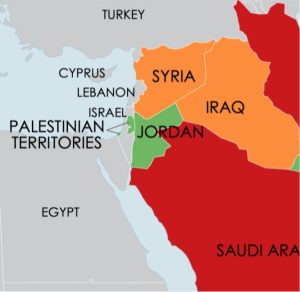
 On 23 October gunmen opened fire on mourners attending a funeral service at St George’s Greek Orthodox Church in the village of Hamoud, Karak governorate, southwest of the Jordanian capital Amman. Nine Christians were killed and forty others injured, at least 27 of whom required hospital treatment.
Masked attackers arrived in a vehicle and began shooting in the street before running towards the church compound where an estimated 170-200 mourners were attending the funeral procession. The attackers entered the building and opened fire indiscriminately – witnesses described scenes of panic as shots rang out, with Christians fleeing or throwing themselves to the ground while also trying to protect their children and help the wounded.
Jordanian authorities described the attack as an act of terrorism, although no group has claimed responsibility. King Abdullah II declared a three-day period of national mourning and said in a statement, “The terrorist attack against Karak will be met with the harshest retaliation. Those who delude themselves into thinking that they can divide Jordanians with their bullets have no chance in the face of our unity.” He visited Karak hours after the attack and said the perpetrators would be punished “with an iron fist”.
Prime Minister Jafar Hassan said in a post on X, “This is a result of a terrorist ideology and blind extremism and we will not allow society to go down this path.”
UN secretary general António Guterres condemned the violence in a post on X and said attacks against civilians and places of worship were unacceptable.
On 25 October the Greek Orthodox Patriarch of Jerusalem, Theophilos III, led a funeral for eight of the victims at St George’s Church and visited some of the injured. Coffins wrapped in Jordanian flags were carried through crowds of thousands towards the church building, where security personnel stood guard. Prime Minister Hassan attended the funeral alongside government ministers and senior military and civilian officials. The ninth victim was buried the following day.
On 26 October security forces arrested three suspects following a dawn shootout at an abandoned house where they were hiding in al-Jadeeda village, close to Hamoud. The suspects are reportedly Jordanians from one family (two brothers and their brother-in-law). They refused to surrender and attacked security forces who returned fire and arrested them, severely injured.
Jordan’s Director of Public Security, Major General Obaidallah Abd Rabbo Al-Maayta, told a news conference that the gunmen were not tied to any organised group. “They only represent themselves,” he said, adding that a large cache of munitions was found in the abandoned house where they were found.
Jordan carries out airstrikes on Syria
On the evening of Monday 26 October Jordan carried out airstrikes against armed groups in Syria in retaliation for Friday’s attack – the Jordanian air force said the operation “resulted in the killing and wounding of many members of these terrorist groups,” but did not name the groups.
Several civilians were killed in the airstrikes and there was outcry in Syria, where the civil defence agency said it had recovered the bodies of seven people killed in strikes in the southern Daraa and Sweida provinces. Five members of one family (including three children) died in one strike, while two men aged 80 and 60 were killed in separate strikes.
On 27 October Syria closed the Nasib border crossing, a major route connecting the south of the country with Jordan. It was reopened the following day amid news that Damascus and Amman had agreed to establish a joint security committee to investigate the strikes, following a telephone conversation between the Foreign Ministers of the two countries.
“We are wounded”
Christians in Jordan enjoy relative religious freedom and despite being a small minority (between 2 and 3 percent of the population) they are well integrated into the country’s political and social institutions, although converts from Islam can encounter hostility from extremist groups, members of their families or community and the authorities.
Coptic Solidarity reports that the Christian presence in Karak dates back more than 1,500 years, to the period when the region formed part of the Byzantine Empire, and that Karak has long been known for its communities of Christians and Muslims living alongside one another.
Following the shooting, a local church leader told Barnabas Aid, “These are unprecedented times. We mourn with the Church. It is painful to be part of this aching community at this time. We plead with you to pray for us. We are wounded.”
(Associated Press, Barnabas Aid, Coptic Solidarity, Guardian, International Christian Concern, Al Jazeera, The New Arab, Open Doors)