
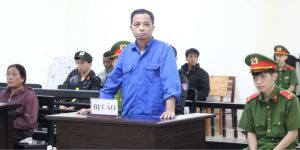
 On 5 August the People’s Court of Dak Lak province sentenced Pastor Y Nuen Ayun (59), who is from the Ede ethnic minority in Vietnam’s Central Highlands, to seven years and six months in prison followed by four years’ probation on a charge of “undermining the policy of national unity”. His defence lawyer says prosecutors failed to establish any specific acts that constitute a crime under Vietnamese law and his church says the sentence is intended to intimidate members into abandoning their faith. The pastor’s wife and children attended the trial, which lasted for around two hours, and the photo shows him in court on 5 August.
Nuen Ayun was arrested at his home on 7 October 2025 and accused of using the Central Highlands Protestant Church of Christ (CHPCC) as a cover for activities that violated national security. His younger brother, who is in exile in Thailand, told BBC News Vietnamese that many police officers raided the house and escorted the pastor to the Dak Lak Provincial Police Department.
Vietnamese newspapers at the time reported police allegations that Pastor Nuen Ayun was the head of the “reactionary organisation” of the CHCEC and was “using religion as a cover to carry out activities that infringe upon national security“.
Prosecutors alleged that he received more than 7.7 million dong (around €255) from CHPCC founder Pastor A Ga (who is a refugee in the United States) to support the organisation, with the aim of establishing a separate religious organisation for ethnic minorities outside government control and eventually creating a separate state.
On 29 April 2026 the Security Investigation Agency of the Dak Lak Provincial Police issued its investigation conclusion, accusing Pastor Nuen Ayun of committing the crime of “undermining the policy of national unity” under Article 116 of the Penal Code and recommending that the Dak Lak Provincial People’s Procuracy prosecute him in court. Pastor A Ga was prosecuted in absentia in 2023 on the same charge.
The CHPCC is not recognised by the Vietnamese government and Nuen Ayun has previously been detained and questioned several times. The church says members have faced police harassment and questioning since it was founded and that the pastor’s imprisonment is intended to intimidate members. Pastor A Ga told BBC News Vietnamese that Neun Ayun is just a simple farmer pastor imprisoned by the government to “intimidate those who remain in the Evangelical Church of Christ, forcing them to abandon their faith“.
Defence lawyer disputes allegations
During the court session Nuen Ayun’s lawyer Ha Huy Son disputed the allegations against his client, saying the indictment failed to identify any actions committed that caused division between the people and the government, the armed forces and socio-political organisations, as stipulated under Article 116 of Vietnam’s Criminal Code.
He said the indictment stated that Nuen Ayun “established and operated a church, propagated and developed followers; participated in and organised fellowship on the internet and in person at church group meetings” but argued that “these actions themselves do not equate to acts ‘aimed at opposing the people’s government’“.
After the trial Ha Huy Son wrote on Facebook: “The defendant participated in the activities of the Central Highlands Protestant Church of Christ without any motive or purpose to oppose the people’s government. The defendant only understood that the establishment of the church was registered with the government but not yet officially recognised, and that the law did not prohibit it.”
He wrote that the indictment accused the pastor’s church of being a “reactionary organisation” but that it “does not provide any evidence to support this claim“.
Background
Most Protestants in Vietnam are members of ethnic minorities in the Central and Northwest Highlands, where they are persecuted for their faith (Christianity is seen as a western religion) and for their ethnicity (fear of tribal separatism). In recent decades hundreds of thousands of tribal people in these regions have become Christians and they meet in unregistered house churches.
Churches are required to register with the authorities and unregistered churches are banned, but registration is difficult to obtain and many house churches say they have been trying to register unsuccessfully for years. Unregistered churches, especially in the Central and Northwest Highlands, report government and police harassment including monitoring, travel restriction, disruption of meetings, detention, prosecution and property seizure or destruction.
In its 2026 report, the US Commission on International Religious Freedom stated that religious freedom conditions in Vietnam remain poor, with the government continuing to exert pressure on unregistered religious groups.
Read more about the persecution of Christians in Vietnam in Church in Chains’ Vietnam Country Profile.
(UCA News, BBC News Vietnamese, Church in Chains Vietnam Country Profile)
Photo: Vietnamese state media