
 Dr Khataza Gondwe, Co-Director of Advocacy and Team Leader for Africa and the Middle East at Christian Solidarity Worldwide (CSW), spoke to attendees at the Church in Chains Supporters Day in Dublin about the ongoing persecution facing Christians in sub-Saharan Africa and particularly in Nigeria, Sudan and Eritrea.
Khataza said this persecution is often overlooked in the West for a number of reasons, including the association of Christianity with empire. Quoting London-based Anglican priest Rev Giles Fraser she said, “so if you speak up for Christians, you’re speaking up for some kind of bad guys. There’s also that fear that, on some sub-conscious level, the secular and broadly progressive West thinks Christianity had it coming because of its colonial past.” She said another reason is that the word persecution has been often misused in the West to describe cases where Christians have come into conflict with contested areas of the law in areas such as free speech.
Khataza went on to outline the internationally-accepted definition of persecution as outlined by the International Criminal Court: “Persecution is the intentional and severe deprivation of fundamental rights contrary to international law by reason of the identity of the group or collectivity. So it can be religious, political, gender based, but that is how persecution is described and it’s actually a crime against humanity”. Khataza pointed out that this also fits into the biblical definition in Hebrews 11 v 36, 37 in terms of what the heroes of faith went through: “Some faced jeers and flogging, and even chains and imprisonment. They were put to death by stoning; they were sawed in two; they were killed by the sword. They went about in sheepskins and goatskins, destitute, persecuted and mistreated.”
Visit to Nigeria
Khataza told attendees that she had recently returned from a visit to Nigeria in which she witnessed situations that were deeply disturbing, particularly the plight of women.
She outlined how she had been working on Nigeria since 2001: “There has been an abiding repression that predates colonial times, and it’s like a system of marginalisation that has been put into place in northern Nigeria in particular to suppress the Christian community, and particularly in the Sharia states in the north. And there you see quite often the abduction of Christian girls (13-15 year olds) on the way to school, The girls just disappear and the next thing parents hear is that they have converted, and they’re no longer your daughter, and they want nothing to do with you. When the parents go to the police, the police would rather not do anything because they don’t want to disturb the peace of the country. So people lose their daughters in that way often.”
Khataza went on to speak about the rise of various transnational terrorist factions including Islamic State West Africa Province, Boko Haram and other groups and the persistent reports of complicity among elements of the security service and also within the government itself. She spoke about a raid by the Lakurawa terrorist group on a village in Kebbi state in northwest Nigeria the previous week, in which Christians were given a four-point ultimatum: “You either pay tax, so that you can continue living in your own ancestral home and functioning, or you renounce Christianity completely, leave the community or convert to Islam. So these poor people don’t know what to do. You want to think that the government will go and send protection to them, and that’s what we’re asking for, and that’s what we’re praying for.”
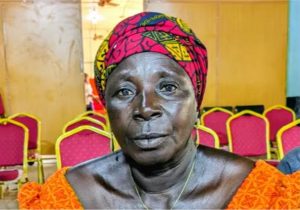 Khataza also spoke of the Fulani militia operating in the Middle Belt region and increasingly in the south and southeast targeting Christian communities and forcibly altering the ethno-religious demography. She spoke of interviewing a woman (pictured) who lost her husband, one of her sons, her brother-in-law and another relative in an attack and had been left destitute because the bread winners are gone.
Outlining the scale of the suffering of Nigeria’s Christians, including many who have been abducted for ransom, Khataza said, “We’re just praying for mercy and for God’s deliverance for these people because they have suffered enough”.
Khataza highlighted some of the initiatives being taken by CSW Nigeria to meet the needs of Christians who have suffered persecution including running psychosocial workshops that help victims to process their experiences and survive the trauma. “In rolling out such programmes in Nigeria, they identified that the missing link that they really needed was forgiveness,” she explained. “And I watched three tough sessions of forgiveness being discussed and shared and trained and people working their way through that and realising it’s not about saying, you did this to me but it’s about you letting it go so you can continue with your life. And people at the end of it wrote down the issues that they felt they needed God’s help to let go of and then they burnt the little notes of the issues to ashes – symbolically setting people free.”
She also highlighted a skills workshop in which participants were given sewing machines and taught how to make bags.
Khataza spoke about advocacy training being offered by CSW Nigeria to empower Christians to stand up for justice in their communities and separate training being given to journalists about reporting on religious freedom issues. She also highlighted how CSW Nigeria had arranged for the United Nations Special Rapporteur on Freedom of Religion or Belief to visit Nigeria to meet victims of religiously-motivated violence.
Sudan
Speaking about Sudan, Khataza said that it is the worst humanitarian crisis in the world at the moment with huge displacement both inside and outside the country. There have been many attacks on churches and Christians. She said that CSW had worked with the UN fact-finding mission on Sudan and is currently working towards the renewal of its mandate at the UN Human Rights Council because it is amassing information that can be used at the International Criminal Court to prosecute those who have brutalised the people. CSW has also given humanitarian support to look after some of the 700 Christian families who were displaced by armed forces and left destitute.
Eritrea
Turning to Eritrea, Khataza told attendees that this weekend was the 25th anniversary of the death of democracy in the country, when President Isaias Afewerki put all reform-minded politicians into a purpose-built prison where they continue to be held, dying slowly. She reported the latest violation of freedom in the country by which citizens are required to deposit all their money in banks but are restricted as to how much cash they can hold or withdraw.
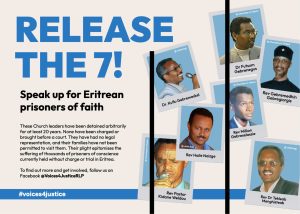 At least 20,000 people are held in over 300 detention sites across the country and torture is routine. Currently around 400 Christians of all denominations – including permitted ones – are detained arbitrarily. Showing a slide of seven long-term Christian prisoners (pastors who have been held for over 20 years) she said that we continue to pray for these men and that they are symbolic of the others in prison. She encouraged attendees to keep remembering them and keep praying for them. In terms of advocacy, CSW has raised the cases of the seven pastors with the United Nations Working Groups on Arbitrary Detention and Enforced Disappearances and has worked with other organisations and former Christian prisoner Helen Berhane on securing the renewal of the mandate of the UN Special Rapporteur on the situation of human rights in Eritrea.
Questions and Answers
In the question and answer session that followed, Khataza dealt with questions including:
- Why isn’t the ongoing persecution of Christians in Nigeria recognised internationally as a crime against humanity?
- What has been the long-term effect of the intervention of US President Donald Trump which included a missile attack on a terrorist group in northwest Nigeria?
- What is your experience of working with the Catholic Church in Nigeria?
- How do you and others working in your field keep yourself from becoming depressed, overwhelmed and despairing with the circumstances that you encounter and the lack of interest by the world in general?
- How can I encourage friends in Nigerian churches in Ireland to comfort their persecuted brothers and sisters in Nigeria and also to encourage them to use their influence to help?