
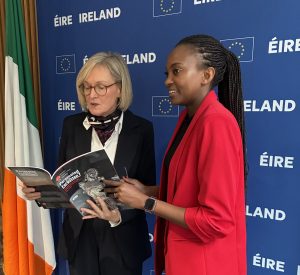
“I want those facing persecution for their faith to realise that we are listening. We are acting, but I think your challenge to us is are we doing enough?” said Mairead McGuinness (EU Special Envoy for the Promotion of Freedom of Religion or Belief Outside the European Union) in Dublin this week. She was speaking at the launch of “Persecuted and Forgotten?” – a report produced by Aid to the Church in Need, the leading Catholic charity focusing on Christian persecution around the world. Church in Chains was represented at the launch by director David Turner.
Ms McGuinness made the keynote speech at the event held in Europe House, the home of the European Commission in central Dublin. She began by referring back to the time of the Penal Laws in Ireland when Catholics, Presbyterians and other Dissenters not part of the Established Church were restricted in worship and shut out of public life. She spoke of Daniel O’Connell’s campaign for Catholic Emancipation and his later support for Jewish Emancipation as he believed that everyone is entitled to religious and civil liberties. Ms McGuinness drew attention to the fact that the concept of religious freedom was written into the Irish Constitution a century later and became part of the Universal Declaration of Human Rights in 1948.
More recently, the adoption of the EU Guidelines on Freedom of Religion or Belief in 2013 (in which Ireland played a leading role) subsequently led to the creation of the role to which Ms McGuinness was appointed in March. She described her experience in the role saying, “Since March, I have stayed very close to people on the ground, I met faith leaders, faith communities, other confessional organisations, and I have to say, very few of these meetings make you smile. It’s certainly not a task for the fainthearted, because you’re the essential hands of communities and individuals who are not free.”
“In my role as envoy, I can’t directly open the prison door”
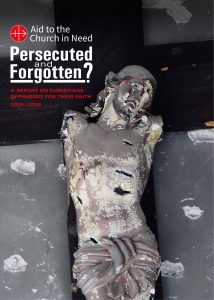 She commented on some of the report’s findings: “If you even own a Bible, are going to take part in worship of any kind, you can be arrested and imprisoned for very long periods. Now, I know that in my role as envoy, I can’t directly open the prison door, stop the militia, but I can make sure that what you have documented is heard where decisions are made, in Brussels, and elsewhere. And that’s why I’m particularly grateful for detailed reports, such as these, but more importantly, for getting in the room with you. Because presence, I think, is also very important.
“While you deal with Christian situations, this is also an issue for other faith groups, and indeed for nonbelievers. The foreword to this report is by Peter Bhatti whose brother, Shabhaz, was Federal Minister for Minorities in Pakistan, and the only Christian in the government. Many will remember the case of Asia Bibi, because this man defended this Christian woman who was sentenced to death under Pakistan’s blasphemy laws. He was killed for defending her. And her story resonates because I think many of you will be aware of the time she spent in prison before she eventually got free. But we also remember another man, the Governor [of Punjab] who was shot dead by his own bodyguard for also defending Asia Bibi. And Salman Taseer was a Muslim. So here we had a Christian and a Muslim, killed for the same act of conscience.”
Drawing her speech to a close, Ms McGuinness drew attention to the fact that in January, Ireland takes a seat on the United Nations Human Rights Council, and she expressed the hope that freedom of religion will be one of Ireland’s priorities there.
In the Question and Answer session that followed, David Turner asked the Special Envoy if she would consider raising individual cases of persecution as he said that, in his experience, bland general government statements were often ignored. She agreed that previous Special Envoys had highlighted individual cases and that she would be open to doing so.
Senator Rónán Mullen spoke of how he had suggested that Ireland appoint a FoRB envoy and asked Ms McGuinness for her assessment on how the Irish government is doing on FoRB issues. In response, she said that she doesn’t criticise any government. She did comment on the importance of individual countries having a FoRB envoy and said that she would be meeting with the FoRB envoys of other EU states in the New Year.
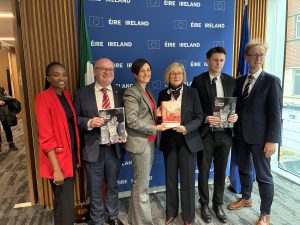 The launch was also addressed by Dr Fearghas Ó Béara, the head of the European Parliament Liaison Office in Ireland (pictured far right of group photo), who spoke of how Christians are the most persecuted religious group in the world and said “we have to make sure they are not forgotten”. He emphasised that solidarity between different religious and societal groups is important and referred to the underlying principle of international foundational human rights documents applying to everyone equally.
Dr Brandon Scott, Promotion and Communications Officer with Aid to the Church in Need Ireland, spoke about an information vacuum that exists in the West in media and politics around the issue of Christian persecution. This vacuum leads to many finding reports of persecution of Christians hard to believe and he said that this myth needs to be exposed through evidence.
He said that the situation around the world was worsening and attributed much of the persecution to two main factors, authoritarianism and jihadism. He spoke about authoritarian leaders in China, India, Pakistan and Nicaragua clamping down on religious freedom and viewing Christianity as a threat. Regarding jihadism, he described the Sahel region in Africa as the epicentre of persecution with particular reference to attacks on Christians in Nigeria, adding that six of the top ten countries listed in the Global Terrorism Index are in the Sahel.
The report can be accessed here