
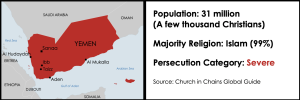
The people of Yemen have endured years of severe suffering, with political instability and poverty greatly intensified by the ongoing civil war, which began in 2014 and has led to one of the worst humanitarian crises in the world. Infrastructure, basic services and the economy have been devastated and around twenty million people are in need of humanitarian assistance.
Located in the south of the Arabian Peninsula, Yemen is one of the most dangerous countries for Christians, who face persecution from authorities, Islamist extremist groups, family and community.
The Republic of Yemen was created in 1990 when the Yemen Arab Republic (North Yemen) merged with the communist People’s Democratic Republic of Yemen (South Yemen) after years of conflict.
In 2011, protests inspired by the Arab Spring forced President Ali Abdullah Saleh to resign after ruling for 33 years and political chaos followed. The Houthis, a Shia group also known as Ansar Allah, seized much of the north and west of the country and took the capital Sanaa in 2014, driving out the government.
Civil war broke out between the northern Houthi rebels, backed by Iran, and government forces backed by a Saudi-led coalition. The internationally-recognised government had moved to Aden in the south, but in 2018 a southern Yemeni separatist group, the UAE-backed Southern Transitional Council, seized Aden and the government left to base itself in Riyadh, Saudi Arabia.
In 2022 President Abdrabbuh Mansour Hadi ceded power to a new Presidential Leadership Council, a coalition established to unify anti-Houthi forces and lead the fractured country forward. The international community recognises the Aden-based Council as Yemen’s official government, but the Houthis still control around a third of the country, mainly in the north and west, including Sanaa.
Religious background
Over 99% of the population of Yemen is Muslim (approximately 65% Sunni and 35% Shia) and the constitution identifies Islam as the state religion and establishes Sharia as the foundation of all legislation.
Yemen’s Penal Code prescribes a punishment of up to five years’ imprisonment for blasphemy against Islam and the death penalty for apostates who refuse to repent within thirty days. There have been no known judicial executions for apostasy in recent years, but there have been occasional murders for apostasy by members of the converts’ communities or Islamist extremist groups such as al-Qaeda and Islamic State.
Christians in Yemen
Before the civil war Yemen’s Christian population, estimated at around 41,000, was largely comprised of migrants and other expatriates, but most have now left and the church mainly comprises a few thousand Christian converts from Islam. They can only meet secretly in small groups in homes, facing danger from warring parties and Islamist groups.
Christians in the Houthi-controlled northwest face brutal repression if they are discovered, including arrest and torture, while Islamist extremists pose a significant threat in the south. Other faith groups at risk of persecution include Baháʼís and Jews, although almost all Jews have now fled Yemen or been expelled by authorities.
Christian converts also face harassment and violence from family and tribe and potential loss of employment and family relationships. Despite severe persecution, however, some mission groups report that the number of indigenous Christians is growing.
The Houthis began a campaign of arbitrary detention against Christians in November 2025, and by February 2026 dozens of Christians had been arrested. The authorities raided homes and arrested Christians by force, without showing arrest warrants or stating any reason.
The Houthis have also arrested dozens of UN workers and civil society staff, while all sides of the conflict (including Houthis, the Southern Transitional Council and the government) arbitrarily detain, disappear and torture journalists and media workers.
In 2025 USCIRF reported that the Houthis have discriminated against Christians and Baha’is in aid distribution during the civil war and that in several cases Houthi hospitals have refused medical treatment to Christians.
(Church in Chains Global Guide, Human Rights Watch Yemen World Report 2026, International Christian Concern, Jubilee Campaign Submission to UPR April-May 2024, Middle East Concern, National Council for Minorities in Yemen, World Evangelical Alliance UPR Stakeholders’ Report October 2023 “Yemen: Religious Freedom and Status of the Christian Church”, United Nations News, United States Commission on International Religious Freedom Factsheet August 2025 “Religious freedom in Houthi-controlled areas of Yemen”, World Watch List 2026)