
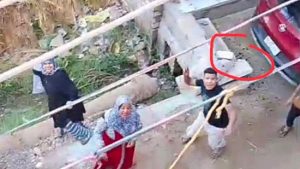
 A mob surrounded and attacked a Coptic church building in the village of Tal Al-Quiblya, 250 km south of Cairo, in Upper Egypt’s Minya province on 8 July as local Christians attended mass. Dozens of Muslims including children and teenagers threw stones, shouted insults and chanted hate slogans. Several Christians sustained injuries when they were struck by stones and the church building was damaged, while the mob also stoned the doors and windows of several Coptic homes and smashed the windows of Father Pavlos Kamal’s car.
The Copts called police, who were unable to control the situation until the Minya Security Chief arrived in the village with rapid-response units and central security forces. They detained a group of Muslims but also detained four Christian men, among them two who had been verbally and physically attacked, a third whose wife had been beaten and a fourth who was filming the incident on his phone. The four Copts were released on 10 July after they withdrew their complaint against their attackers.
Father Kamal had informed security authorities of earlier incidents of incitement and harassment during religious services but the authorities had failed to take any preventative action, and local Christians now say they feel afraid in their homes and in the streets of their village, despite heavy security presence throughout the area.
On the day of the incident Anba Macarius, Bishop of Minya, posted on his official X account that the Copts in the village had come under renewed attack, saying that a group of assailants had vandalised the priest’s car, prevented worshippers from safely leaving the church and cut off electricity to the area in what he described as an escalation to harassments that had occurred during the previous week, of which local security authorities had been informed but had taken no action.
Coptic news Source Watani reported that investigative authorities in Minya ordered the release of all who had been detained pending investigation into the attack following “voluntary conciliation between the Copts and the Muslim detainees, whereby they officially dropped claims against one another”.
Background
For many years Tal Al-Quiblya did not have a church building, despite being home to around forty Coptic extended families. Christians had to travel long distances to neighbouring villages to attend services, causing overcrowding and logistical issues for those churches.
To solve the problem Tal Al-Quiblya’s Copts began to organise church gatherings in their homes on a rotating basis, but the distances they had to travel to some homes impacted their ability to attend regularly so they designated a building owned by Copts in the village as a church – a move that the Egyptian Initiative for Personal Rights (EIPR) said was “made with the knowledge of both security authorities and the village’s Muslim residents” although the church was still waiting for its status to be legalised.
The EIPR criticised the way local authorities handled ongoing sectarian tensions in the village, stating: “The attacks occurred despite the fact that the church priest, Father Pavlos Kamal, had notified security authorities about incitement and harassment during previous religious services – yet the authorities failed to intervene pre-emptively to prevent the attacks.”
The recent incident was sparked after a truck transporting supplies from the church parked in front of the home of a police officer who engaged in a verbal dispute with a local Christian accompanying the driver. Other Christians and Muslims arrived at the scene and the altercation escalated into an attack on the Christians.
EIPR appeals for amendments to 2016 Law for Building and Restoring Churches
In 2016 the Egyptian parliament passed the Law for Building and Restoring Churches, intended to make it quicker and easier to obtain permission to construct and repair church buildings and to make provision for legalising the status of Egypt’s approximately 5,000 unlicenced church buildings. A cabinet committee began work in 2017 and has approved the legalisation of over 3,804 churches, but when the authorities started making site visits to assess applications some extremist Muslims intent on ridding their villages of churches protested and attacked local Christians.
The EIPR notes that despite positive steps taken under the 2016 law, “the legislation has failed to achieve its stated goal of ensuring the construction and renovation of churches without burdensome administrative hurdles”, notably obstacles in areas where Christians lack places of worship.
It calls for the law to be amended to remove legal and procedural obstacles, and urges the Prime Minister to issue a decree legalising all churches where religious services are actively held and which have applications pending before the legalisation committee.
The EIPR calls on the authorities to facilitate the legalisation of the Tal Al-Quiblya church’s status, ensuring that religious rites can be practiced freely and safely, and demands the prosecution of those responsible for the violence.
Read more about the situation facing Copts in Church in Chains’ Egypt Country Profile.
(Christian Solidarity Worldwide, Egyptian Initiative for Personal Rights, Watani)
Photo: Christian Solidarity Worldwide