
 A new joint report by Article 18, Middle East Concern, CSW and Open Doors titled Scapegoats: Rights Violations Against Christians in Iran was released on 19 February. It begins by referring to the protests that erupted at the end of December 2025, which led to “weeks-long nationwide demonstrations calling for an end to the Islamic Republic’s leadership of the country”. It continues, “The response to those protests has been horrifying, with reports of many thousands killed, including several Christians, and every Iranian – regardless of their religious background – affected.
“The road ahead for Iran appears far from clear, but as we release this latest annual report of rights violations committed against Christians in 2025, we stand with the people of Iran in their call for leaders who will act on their behalf, rather than repress them. For 47 years, the Iranian people have been subjected to a regime that not only consistently fails to uphold human rights for its citizens, but brutally quashes dissenting voices, opinions or beliefs. This report details the violations throughout 2025 experienced by just one section of society – the Christian community.”
The report describes the 12-day war with Israel last June as a “pivotal moment in 2025, which impacted all Iranians but left minorities especially vulnerable to targeting and scapegoating” and adds that “After the cessation of hostilities on 24 June, a group of United Nations experts issued a statement about the ‘intensified risk of [minorities] being scapegoated at this time of heightened political pressure’.”
Within the next month at least 54 Christians were arrested in 19 cities, with Iran’s Ministry of Intelligence and Security (MOIS) labelling them “Mossad mercenaries” (referring to Israel’s intelligence agency) who had been “trained abroad under the guise of the ‘Zionist’ Christian evangelisation movement”.
Key findings
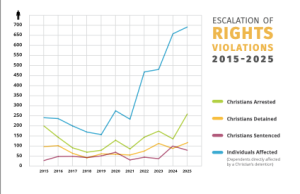
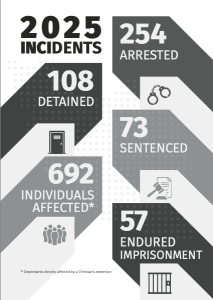 Nearly twice as many Christians were arrested on charges related to their religious beliefs or activities in 2025 (254) as in the previous year (139), while more than twice as many Christians were serving sentences of imprisonment, exile or forced labour in 2025 (57) as in 2024 (25). At the end of the year 43 Christians were still serving sentences, with at least 16 others in pre-trial detention.
Although fewer Christians were sentenced in 2025 (73) than in 2024 (96) the combined total of their sentences (280 years) was higher than in 2024 (263 years), reflecting a trend towards longer sentences – eleven Christians received sentences of ten years or more in 2025. In addition, Christians were given sentences totalling 249 years of social deprivation and nine years in exile.
Trends
Several trends were noted in the report:
- A “sharp increase” in arrests of Christians following the war with Israel, confirmed
 in a statement by the MOIS that 53 “trained elements” (evangelical Christians) had been “neutralised”
 - Hate speech from government-linked sources against Christians and other religious minorities
- Increasing involvement of the Islamic Revolutionary Guard Corps in the arrests of Christians (in previous years the MOIS was the main government body responsible for monitoring and gathering evidence against Christians, and the increasing role of the IRGC in intelligence gathering and prosecutions shows that the regime perceives Christians as a threat)
- Criminalisation of Bible possession and distribution: at least 21 Christians received custodial sentences in 2025 related to alleged involvement in the distribution of Bibles in Iran, in addition to other punishments including fines, exile and social deprivation
- Widespread and increasing use of Article 500 of the penal code: in nearly ninety percent of cases in 2025, charges against Christians were brought under Article 500, which was amended in 2021 and criminalises “propaganda contrary to the holy religion of Islam”
- Training abroad monitored and included in chargesheet (Christians often travel abroad for theological training, lacking opportunity at home)
- Longer prison sentences
- Mistreatment of detained Christians, including denial of healthcare and psychological torture (in December, the US Commission on International Religious Freedom named Evin Prison, where most Christian prisoners are held, among five facilities worldwide where religious prisoners of conscience are most mistreated)
Recommendations
The report makes many recommendations to the government of Iran, the international community and the UN and its Special Rapporteurs and Fact-Finding Mission.
Its recommendations to the government include calls to: release Christians and other minorities detained on charges related to their beliefs or religious activities; drop all charges related to ordinary church activities such as baptism, communion and gathering for prayer or Bible study; end the criminalisation of house churches and permit the registration of official places of worship for Christians of all ethnic and language groups; and reopen the Bible Society (which has been under “temporary closure” since 1990) and permit the printing and distribution of Bibles in Iran.
The report calls for the international community to hold Iran accountable for its failures to uphold its obligations under international law and to raise these concerns consistently in bilateral and multilateral dialogues, and it calls for fair and informed asylum procedures for Iranian Christians seeking international protection, recognising their well-founded fear of persecution if returned.
Finally, it calls on the United Nations, its Special Rapporteurs and the Independent International Fact-Finding Mission to include the situation of Christians (particularly converts) in all reporting on human rights in Iran, and asks them to urge the government of Iran to provide clarification on its investigation into the closure of the Bible Society, and to indicate under what conditions it may be permitted to reopen.
Read the full report.
Read Church in Chains’ Iran Country Profile.
(Article 18, Middle East Concern)
Images: from report