
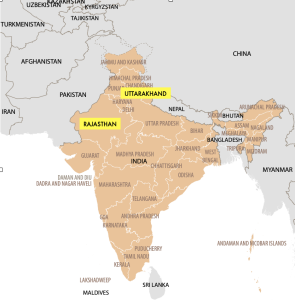
 Uttarakhand state in northern India has passed an amendment to its anti-conversion laws that makes them among the harshest in any state in India. Meanwhile, Rajasthan state in northwest India has passed new anti-conversion laws that also provide for very long prison sentences and heavy fines.
Uttarakhand’s Freedom of Religion (Amendment) Bill, 2025, introduced by the state’s Hindu nationalist Bharatiya Janata Party (BJP) government and passed on 20 August, increases penalties for “forced conversions” up to life in prison and fines of up to 1 million Indian Rupees (€9700). The bill will become law when passed by the state governor, but this is expected to be a formality. The state first introduced anti-conversion laws in 2018 and amended them in 2022.
India’s anti-conversion laws are intended to stop Hindus being converted to other religions and forbid conversion by “force, fraud or allurement” but extremists use them as a licence to attack Christians, claiming they are forcing Hindus to convert. Typically, attackers raid church services, beat those gathered and have pastors arrested on false charges of forcibly converting Hindus.
The new amendments to Uttarakhand’s anti-conversion laws include provision for the following punishments:
- conversion of minors, women, people from Scheduled Castes and Scheduled Tribes and those with mental disabilities: five to 14 years in jail and fines of at least 100,000 Indian Rupees (€970)
- mass conversion: seven to 14 years in jail
- conversion involving foreign funding: seven to 14 years in jail and fines of at least 1 million Indian Rupees (€9700)
- conversion using force, threat, inducement, trafficking or promise of marriage: twenty years to life in prison and fines of at least 1 million Indian Rupees (€9700).
The definition of inducement or allurement not only includes financial gifts, material benefits and employment but also encompasses statements that allegedly hurt religious faith or glorify one religion over another, and there is particular concern over the fact that Uttarakhand’s amendment includes digital media in its anti-conversion laws, the first state to do so. Its government stated that “acts like promoting or inciting conversion through social media, messaging app or any online medium” will now be forbidden and punishable.
Rev Vijayesh Lal, general secretary of the Evangelical Fellowship of India, commented: “When laws criminalise social media discussions about faith, they threaten every citizen’s fundamental right to religious expression in the digital age. These provisions, with penalties up to life imprisonment, represent some of India’s harshest anti-conversion measures and could turn ordinary conversations about belief into criminal acts.”
Reaction
Rohit Singh, a lawyer in Uttarakhand state, told Morning Star News, “Since the bill was introduced, pastors have been calling me. Many have removed their sermons and social media posts from online platforms. Some pastors are thinking of leaving the state. Online donations have almost stopped to churches and Christian organisations as no one wants to get in trouble. I think our rights have ended in India now.”
John Dayal, spokesman for the All India Catholic Union, told Morning Star News, “Anti-conversion laws are weaponised through vague terminology, procedural abuses and selective enforcement. Terms like ‘force,’ ‘fraud’ and ‘allurement’ are broadly interpreted to include acts like distributing Bibles or providing medical aid.”
A.C. Michael, convenor of the United Christian Forum, condemned the amendments as being “in complete violation of the Constitution of India, which states that all persons are equally entitled to freedom of conscience and the right freely to profess, practice and propagate religion”.
The Times of India described the amendments as “draconian” and “poorly designed legislation” that would create a system where “anyone can be arrested on mere suspicion of ‘intent’” and where “the accused’s property can be seized”.
A local Open Doors partner, who cannot be named for security reasons, commented: “Every prayer meeting is perceived as a conversion gathering. Even acts of social service and kindness by organisations are being alleged as ‘allurement’ for religious conversion by extremists.”
Rajasthan passes anti-conversion bill
On 9 September Rajasthan’s state assembly passed new anti-conversion laws that stipulate twenty years in jail and heavy fines for anyone converting a person to another religion by use of force, coercion, misrepresentation, undue influence, allurement, marriage, or any fraudulent means. The Rajasthan Prohibition of Unlawful Religious Conversion Bill, 2025 makes it a non-bailable crime to convert to another religion without obtaining prior approval from a district official.
The newly-passed bill includes provision for the following punishments:
- conversion by fraudulent means: seven to 14 years in jail and a fine of up to 500,000 Indian Rupees (€4,850)
- mass conversion by fraudulent means: twenty years to life in jail and a fine of 2.5 million rupees (€24,250)
- conversion through deceit of minors, women, Scheduled Castes, Scheduled Tribes and persons with disabilities: ten to twenty years in jail and a fine of at least one million Indian rupees (€9700)
- receiving foreign or illegal funds for conversion activities: ten to twenty years in jail and a fine of at least one million Indian rupees (€9700)
- repeat offending: life imprisonment and a fine of up to five million Indian rupees (€48,500).
Christian leaders say provision of education and health care or even prayer services could be construed as using force, coercion, misrepresentation, undue influence or allurement for conversion.
Local priest Father Basil Makwana told UCA News, “This is an unnecessary law to harass minorities, including Christians. We could be targeted for our daily prayer services, holding a birthday party or other events with false allegations of trying to convert people. The new law will have far-reaching consequences for the safety and security of minority communities, as it shifts the burden of proof from the complainant to the accused, who must now prove they did not commit the crime. Conversion allegations were a serious issue even when there was no such law. Now the new law threatens to become a tool in the hands of troublemakers to target us easily.”
Rajasthan’s BJP government previously passed anti-conversion laws in 2006 and 2008 but they did not receive approval from the state governor, who was a nominee of the Congress Party-led federal government and opposed anti-conversion laws. The BJP is now in power at state and federal level and no opposition is expected from the state governor.
(Morning Star News, NDTV, Open Doors, UCA News)
Map: Church in Chains