
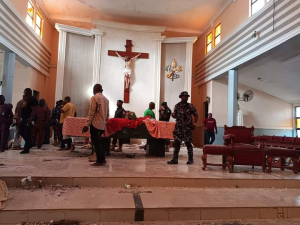
 On 3 June a Federal High Court in the capital Abuja convicted four defendants on terrorism-related charges in connection with a deadly attack on St Francis Catholic Church in Owo in southern Nigeria’s Ondo state on 5 June 2022 and sentenced them to death. At least forty-one people were killed and over one hundred were injured in the attack, which took place during a Pentecost service and was the first terror attack on a church in southern Nigeria.
The trial began in August 2025, following long investigations by the Department of State Security, and the four defendants reportedly pleaded not guilty. They made voluntary confessions, however, stating that they carried out the attack after their leader (who remains at large) informed them that the Catholic church was committing blasphemy by insulting the Prophet Mohammed. They said they were instructed to kill the priest, who survived the attack.
The attackers, armed with AK-47 rifles, reportedly stormed the church, held worshippers hostage and detonated at least three improvised explosive devices, which Punch said “triggered panic and bloodshed among worshippers”.
Justice Emeka Nwite found Idris Abdulmalik Omeiza (25), Al Qasim Idris (20), Jamiu Abdulmalik (26) and Abdulhaleem Idris (25) guilty on a nine-count charge including hostage-taking, kidnapping, terrorism financing and detonating explosives causing death and injury, and sentenced them to death by hanging. The assent of the Nigerian president is required before the death penalty is carried out, and there have not been any executions in Nigeria for several years.
The four men were also sentenced to life in prison for belonging to a terrorist organisation and twenty years each for conspiracy. Their defence lawyer said they would appeal against their sentences.
The court found that the four men were principal members of an al-Shabaab terrorist cell operating in Kogi state, just north of Ondo. They had reportedly joined the al Qaeda-affiliated militant group in 2021 and had also plotted attacks at other locations. Al-Shabaab did not claim responsibility for the attack, however, and neither did Islamic State West Africa Province, which was initially thought to be responsible.
A fifth defendant was acquitted and discharged due to insufficient evidence. Justice Emeka Nwite ruled that the prosecution had failed to prove its case against Momoh Abubakar (47), who made no confession but was found with a large amount of money in his account that he could not explain. The lead counsel for the prosecution said the judgement would be reviewed with the aim of possibly appealing the acquittal.
Reaction
Amid rising insecurity across Nigeria, the convictions send a message that the authorities are motivated to pursue justice and punish attacks on churches.
Speaking to Catholic charity Aid to the Church in Need en route to the church to celebrate Mass to mark the fourth anniversary of the atrocity on 5th June, Dr Jude Arogundade of Ondo, bishop of the diocese that includes Owo, said: “We are pleased that at last the families and victims in general can move towards a kind a closure although we realise that they will never fully reach closure as they will carry the scars of what happened that day for the rest of their lives. Many are still traumatised and are still going through medical treatment and many are on the edge – they are still suffering and worried because they don’t know what will happen next.”
The bishop, who spearheaded the campaign for justice following the atrocity, added: “The Church does not accept the death penalty but it is important that those responsible are held accountable.”
Controversy over President Higgins’ reaction to massacre
In the immediate aftermath of the massacre in Owo in 2022 there was a brief controversy over remarks made by Ireland’s President Michael D. Higgins, who suggested that climate change might have been a factor. He issued a statement in which he said that such an attack was made in a place of worship “is a source of particular condemnation, as is any attempt to scapegoat pastoral peoples who are among the foremost victims of the consequences of climate change”.
Dr Arogundade responded on social media by thanking President Higgins for his condolences but said that he wanted to “set the record straight”. He went on to state, “The massacre at St Francis Church, Owo, has nothing to do with climate change and food security issues in Africa. To suggest or make a connection between victims of terror and consequences of climate change is not only misleading but also rubbing salt to the injuries of all who have suffered terrorism in Nigeria.”
(Aid to the Church in Need, BBC, Christian Solidarity Worldwide, Punch)
Photo: Christian Solidarity Worldwide